
Why this one is bigger than it looks
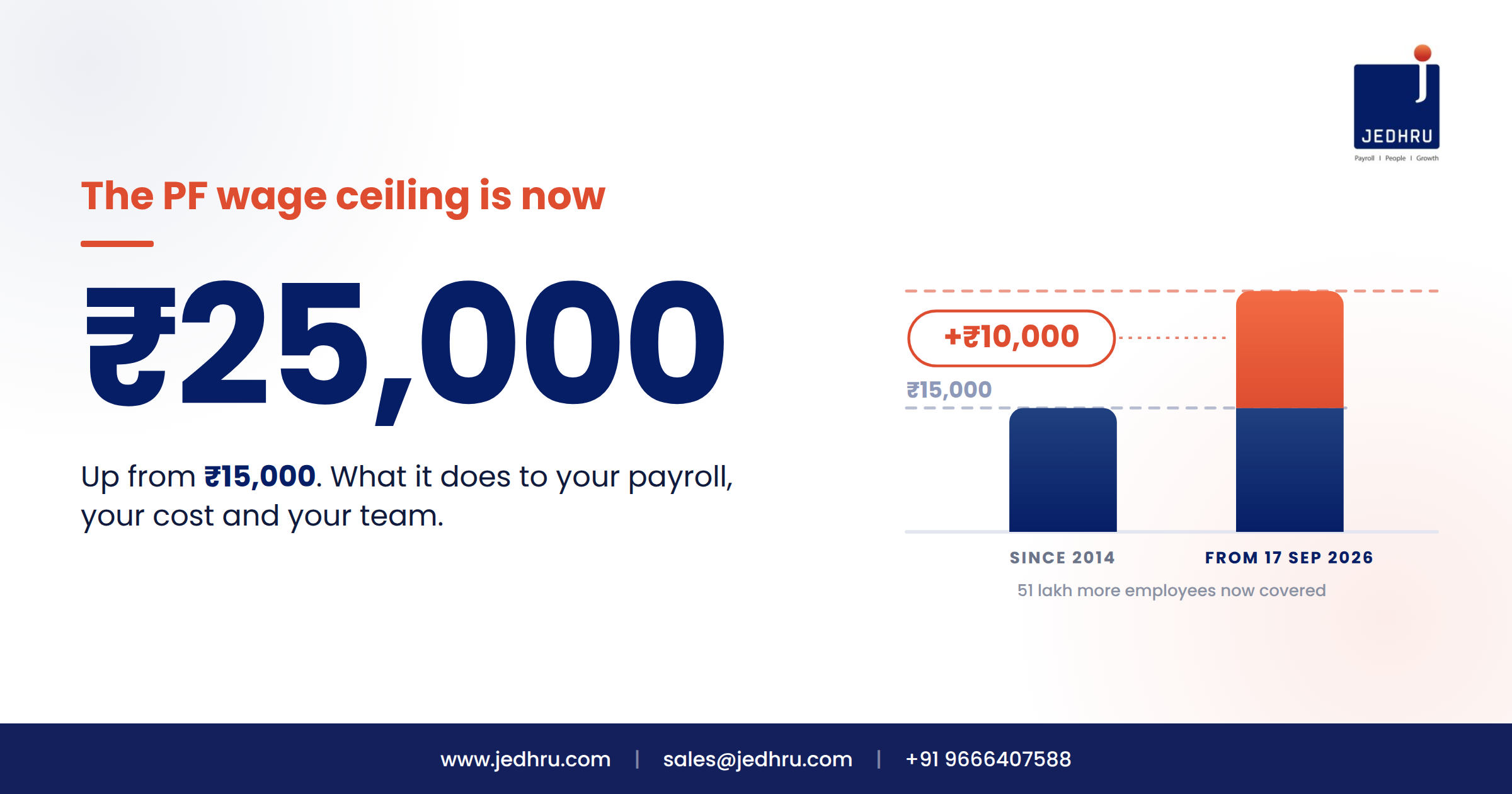
The last time this ceiling moved was September 2014. It went from ₹6,500 to ₹15,000 and then it sat there for twelve years.
Twelve years of salary growth. Twelve years of a ceiling that stayed still.
By 2026 the ₹15,000 line had stopped meaning anything. Most full-time staff in a city earned more than that, so the PF base for a large part of the workforce was frozen at a number nobody actually earned. The pension built on that base got smaller in real terms every year.
The government moved it to ₹25,000 with effect from 17 September 2026. The Cabinet approved it, and the change is being given effect through the schemes under the Code on Social Security, 2020. Central government spending on its own 1.16 percent share of the pension scheme goes from about ₹10,250 crore a year to about ₹11,339 crore a year. Over five years that is around ₹56,696 crore.
That is how you know this is not a small technical fix. The government is putting real money behind it.
The numbers, side by side
Here is the full picture at the ceiling. Every figure is monthly, per employee.
| What | At ₹15,000 | At ₹25,000 | Change |
|---|---|---|---|
| Employee share (12%) | ₹1,800 | ₹3,000 | +₹1,200 |
| Employer to pension, EPS (8.33%) | ₹1,250 | ₹2,083 | +₹833 |
| Employer to PF, EPF (3.67%) | ₹550 | ₹917 | +₹367 |
| EDLI insurance (0.5%) | ₹75 | ₹125 | +₹50 |
| Admin charge (0.5%) | ₹75 | ₹125 | +₹50 |
| Total employer cost (about 13%) | ₹1,950 | ₹3,250 | +₹1,300 |
| Total going into the account | ₹3,600 | ₹6,000 | +₹2,400 |
Per employee, per year, the employer side goes up by about ₹15,600.
If you have 50 people sitting at or above the new ceiling, that is ₹65,000 a month and about ₹7.8 lakh a year.
That is a real number. Put it in your budget before your finance head finds it in the October challan.
One caution on the admin charge. It is 0.5 percent of PF wages with a minimum of ₹500 a month for the establishment. If you are a small team, the minimum is what will apply, not the per-head figure.
Your payroll has four groups of people in it. Not one.
This is where most employers will get it wrong. They will open the payroll software, change 15,000 to 25,000, and hit save.
Do not do that. Your file has four different groups and the change hits each one differently.
Group 1: PF wages below ₹15,000
Nothing changes. They were covered before. They are covered now. Their contribution is on actual wages and it stays on actual wages.
Group 2: PF wages between ₹15,001 and ₹25,000, and not in PF
This is the group the whole reform is about. These people were “excluded employees” before. They were allowed to stay out.
That door is now shut. They come into PF, into the pension scheme and into the EDLI insurance cover.
For these people you need a UAN, KYC, a Form 11 declaration and a clean record of the date they became covered. This is the group that creates the paperwork.
Group 3: already contributing on full wages above ₹15,000
Many good employers already pay PF on the full salary rather than stopping at ₹15,000. If that is you, your total outgo barely moves. Your EDLI and admin charge go up by about ₹100 a month per person and that is it.
But something else happens inside the account, and almost nobody is talking about it.
The pension share was capped at 8.33 percent of ₹15,000, which is ₹1,250. It is now 8.33 percent of ₹25,000, which is ₹2,083. The employer’s 12 percent has not changed. So more of it goes to the pension side and less goes to the PF side.
Same money out of your pocket. Different split inside the employee’s account. Less in the balance they can see and withdraw. More in a pension they will draw at 58.
Your employees will notice the PF balance growing slower and they will ask you why. Have the answer ready before the question comes.
Group 4: PF wages above ₹25,000
Still capped. The statutory base stops at ₹25,000 unless you and the employee both agree to contribute on higher wages under the voluntary route in the scheme.
The revised ceiling on its own does not change their status.
The one that nobody has clean instructions for yet
The change took effect on 17 September 2026. That is the middle of a payroll month.
So what do you do with September?
There are two answers going around. Calculate on a pro-rata basis, with the old ceiling for 1 to 16 September and the new ceiling from 17 September. Or apply the new ceiling cleanly from 1 October.
Here is the practical problem. The ECR portal has never supported two different wage ceilings inside one month. It was not built for it.
My advice is simple. Do not guess, and do not let your software vendor guess for you. Run both versions, keep the working, and wait for the EPFO technical circular before you file. Then file what the circular says and keep your calculation sheet in the audit file.
The other dates you already know. Your UAN generation and KYC for the newly covered staff should be done before you file. The monthly ECR and payment stay on the usual cycle, by the 15th of the following month.
If you want this handled by people who do it every month for a living, that is what Jedhru’s payroll outsourcing does.
The conversation with your team is the hard part
An employee in Group 2 is about to see ₹1,200 less in their bank account. Some of them earn ₹20,000 a month. For them, ₹1,200 is not a rounding error. It is a week of groceries.
If you do not explain it, here is what they will think. The company cut my salary.
So explain it. In one page. In plain words. Before payday, not after.
Tell them three things.
One. The money is not gone. It moved from their bank account to their own PF account, and the company put in a matching amount on top.
Two. The pension gets much bigger. The pension formula is pensionable salary multiplied by years of service, divided by 70. At a ₹15,000 base with 35 years of service, that is about ₹7,500 a month for life. At a ₹25,000 base, it is about ₹12,500 a month. That is a 67 percent jump.
Three. The insurance cover goes up too. EDLI pays the family if an employee dies while in service. The cover has been linked to the ₹15,000 ceiling, with a maximum of ₹7 lakh. With a higher ceiling that maximum should rise.
One warning on that third point. Do not stand in front of your team and promise a specific new EDLI figure. Some articles are quoting ₹10.5 lakh. That number is worked backwards from the formula and it is not confirmed in a notification yet. Say the cover goes up. Give the exact figure when the amendment is out.
Flag what you do not know. It costs you nothing and it keeps your credibility.
Five mistakes I expect to see this quarter
1. Treating gross salary as PF wages. PF is calculated on basic pay, dearness allowance and retaining allowance, not on the full gross. Under the Code on Social Security, if your excluded allowances add up to more than half of total pay, the excess gets added back into wages. Two companies with the same CTC can end up with completely different PF numbers. Get your wage definition right before you touch the ceiling.
2. Applying ₹25,000 to everybody. See the four groups above. A blanket change will overcharge some people and create a correction you have to explain later.
3. Assuming everyone now joins the pension scheme. Employees who joined PF on or after 1 September 2014 on wages above the then ceiling were kept out of EPS. The new ceiling does not quietly flip them back in. Check each person’s joining date, their Form 11 and what EPFO records show, before you change their EPS status.
4. Cutting basic pay to reduce the bill. It is the oldest trick in Indian payroll and it stopped working. The wage definition puts a floor under how low basic can go relative to total pay. All you achieve is a restructuring that invites questions and upsets staff.
5. Trusting the software default. Your payroll system will get an update. That update was written by someone who does not know your wage structure. Run a parallel calculation on ten real employees, compare it line by line with last month, and explain every difference before you file.
What this costs you, and what it is worth
Let us be honest about the cost. For a 200 person company with, say, 80 people in the affected band, you are looking at roughly ₹1 lakh a month more and about ₹12 lakh a year.
Nobody enjoys finding that in a budget.
But look at the other side. Accurate and on time pay is the single strongest thing you can do for employee trust. Research by the Workforce Institute at Kronos found that half of workers start looking for another job after just two problems with their paycheque. Two.
A botched PF transition is exactly the kind of problem that creates. Wrong deduction, confused employee, angry WhatsApp group, no explanation from the company.
The money was always going to be spent. The choice you actually have is whether the transition is clean or messy.
Your checklist
Print this. Work through it in order.
- Export your last filed ECR and your September payroll register. Freeze that as your baseline.
- Pull the list of every employee with PF wages above ₹15,000. Split them into the four groups above.
- For Group 2, check Form 11, UAN, KYC and date of joining for each person.
- Confirm your PF wage definition against the Code on Social Security. Not gross. Not CTC.
- Model the cost. Old versus new, per person and in total, for the next twelve months.
- Decide how the extra employer cost is treated. Absorbed by the company, or inside CTC. Then check your offer letters and salary annexures, because many of them still name the ₹15,000 ceiling in writing.
- Update the ceiling in payroll only after the notification and EPFO circular are confirmed.
- Run a parallel calculation for ten sample employees. Investigate every difference.
- Write the employee communication. One page, plain language, out before payday.
- Keep an audit file with the notification, your configuration screenshots, your test results and your reconciliation.
That is ten steps. Most of them are one-time. Step by step it is manageable.
Doing it while also running hiring, appraisals and your actual job is where it falls apart.
The part I actually care about
Read that checklist again and ask yourself an honest question. Is that an HR admin task?
It is not. It is specialist compliance work with a hard monthly deadline, a legal definition of wages sitting underneath it, a portal that has not caught up yet, and real money on the line.
In India we handed payroll to HR because it arrived as a monthly chore. Collect attendance, apply deductions, print payslips. Chores go to HR.
Look at how the rest of the world does it. The two largest HR companies on earth, ADP and Paychex, were both built as payroll companies first. Everything else came after. That order tells you what the market actually values.
A ceiling change like this is the moment the difference shows up. A specialist already has the four groups mapped, the cost modelled and the employee note drafted. A generalist is reading a news article and hoping the software vendor handles it.
Neither person is at fault. It is a design mistake, not a people problem.
Payroll should sit with people who do only payroll.
Where Jedhru fits
We have been running Indian payroll from Hyderabad since 2011. Payroll, statutory compliance and Employer of Record are the business, not a module inside something else.
For this change, here is what that looks like in practice.
- Payroll outsourcing. Your monthly run with PF, ESI, PT and TDS handled inside the cycle, including the four group split and the September reconciliation.
- Statutory compliance. PF, ESIC, PT, TDS and LWF filings, central and state level, with the audit file kept as we go.
- Employer of Record. If you are hiring in India without your own entity, we are the legal employer and this change is ours to manage, not yours.
- Third party and off-roll payroll. Contract, seasonal and project staff, which is where a wage ceiling change usually creates the most mess.
If you want a second pair of eyes on your ₹15,000 to ₹25,000 cohort before October payroll, talk to us. Even if you never become a client, you should not be finding this out from an EPFO notice.
One note on what we are. Jedhru is a compliance practice, not a law firm. This piece is practitioner guidance, not legal advice. For your own establishment, the notification and the EPFO circular are the authority, not a blog post. Including this one.
Common questions
What is the new PF wage ceiling in India? The wage ceiling for compulsory Provident Fund coverage is ₹25,000 a month, with effect from 17 September 2026. It was ₹15,000 before that, a level set in September 2014 and unchanged for twelve years.
Did the PF contribution rate change? No. The employee contributes 12 percent of PF wages and the employer contributes 12 percent. Within the employer’s 12 percent, 8.33 percent goes to the pension scheme and 3.67 percent goes to PF. On top of that, the employer pays 0.5 percent for EDLI insurance and 0.5 percent as an administration charge, with a minimum of ₹500 a month for the establishment. Only the ceiling changed, not the rates.
How much more does an employer pay per employee? At the full ceiling, employer cost goes from ₹1,950 a month to ₹3,250 a month. That is ₹1,300 more per employee per month, or about ₹15,600 a year. For employees already contributing on their full wages above ₹15,000, the increase is only around ₹100 a month, from EDLI and the administration charge.
How much less take-home pay will employees get? At the full ceiling, the employee’s own contribution goes from ₹1,800 to ₹3,000 a month. That is ₹1,200 less in hand. The money moves into their own PF account and the employer adds a matching contribution on top of it.
Who is affected by the new PF ceiling? About 51 lakh additional employees across India, mainly those earning PF wages between ₹15,001 and ₹25,000 a month who were previously treated as excluded employees. Employees below ₹15,000 see no change. Employees already contributing on full wages above ₹15,000 see their pension share rise and their PF share fall, with the same total employer outgo. Employees above ₹25,000 stay capped unless both sides agree to contribute on higher wages.
How does the higher ceiling change the pension? The pension formula is pensionable salary multiplied by pensionable service, divided by 70. With 35 years of service, a ₹15,000 base gives about ₹7,500 a month. A ₹25,000 base gives about ₹12,500 a month. That is roughly 67 percent more. Past service is still calculated under the earlier rules, so the higher ceiling applies from here on, not backwards.
How should September 2026 payroll be calculated? The change took effect on 17 September 2026, in the middle of a payroll month. One approach is pro-rata, with the ₹15,000 ceiling for 1 to 16 September and ₹25,000 from 17 September. Another is applying the new ceiling cleanly from 1 October. The ECR portal has not historically supported two ceilings in one month, so employers should prepare both calculations and follow the EPFO technical circular before filing.
Do employees who joined after September 2014 above the old ceiling now get EPS? Not automatically. Employees who joined PF on or after 1 September 2014 with wages above the then ceiling were excluded from the pension scheme. The revised ceiling does not by itself convert them into pension members. Each case needs a check of date of joining, Form 11 and EPFO records.
Does the EDLI insurance payout go up? The EDLI benefit is linked to the wage ceiling, and the maximum under the ₹15,000 ceiling was ₹7 lakh. A higher ceiling should raise that maximum. Figures such as ₹10.5 lakh are being worked backwards from the formula and are not confirmed in a notification yet. Employers should not promise a specific new amount until the scheme amendment is published.
Can we cut basic pay to reduce the PF cost? It does not work the way it used to. Under the Code on Social Security, 2020, if excluded allowances exceed half of total pay, the excess is added back into wages for PF purposes. Restructuring salaries purely to lower PF creates dispute risk and scrutiny for very little saving.
Should we outsource payroll because of this change? This change is a fair test of whoever runs your payroll. It needs a correct wage definition, employee level classification into four different groups, a pro-rata decision for September, cost modelling, offer letter fixes and a clear employee communication, all in one cycle. If that sits on top of a generalist HR role along with hiring and appraisals, the risk of error is high. A payroll specialist does this work every month for many clients and carries accountability for getting it right.