
By Narayana Murthy, Chief Executive Officer, Jedhru Informatics. Jedhru runs payroll, statutory compliance and Employer of Record services in India, so read this knowing where I sit. Everything below is what my team walks a Singapore client through before the first hire.
Last updated: September 2026. Indian law references reflect the four Labour Codes in force from 21 November 2025 and the PF wage ceiling of ₹25,000 from 17 September 2026.
Why so many Singapore companies hire in India
Singapore is India’s largest source of foreign investment. According to DPIIT data, Singapore contributed about US$19.8 billion in FDI equity during FY 2025-26, more than any other country. Cumulative Singapore equity inflows since April 2000 reached about US$199.9 billion by June 2026, roughly a quarter of India’s total.
That money comes with people. Singapore companies hire in India for engineering, product, finance operations, customer support and sales. The reasons are simple:
- Talent depth. India has one of the largest pools of software, finance and operations talent in the world.
- Cost. A strong engineer in Hyderabad or Bengaluru typically costs a fraction of the same role in Singapore.
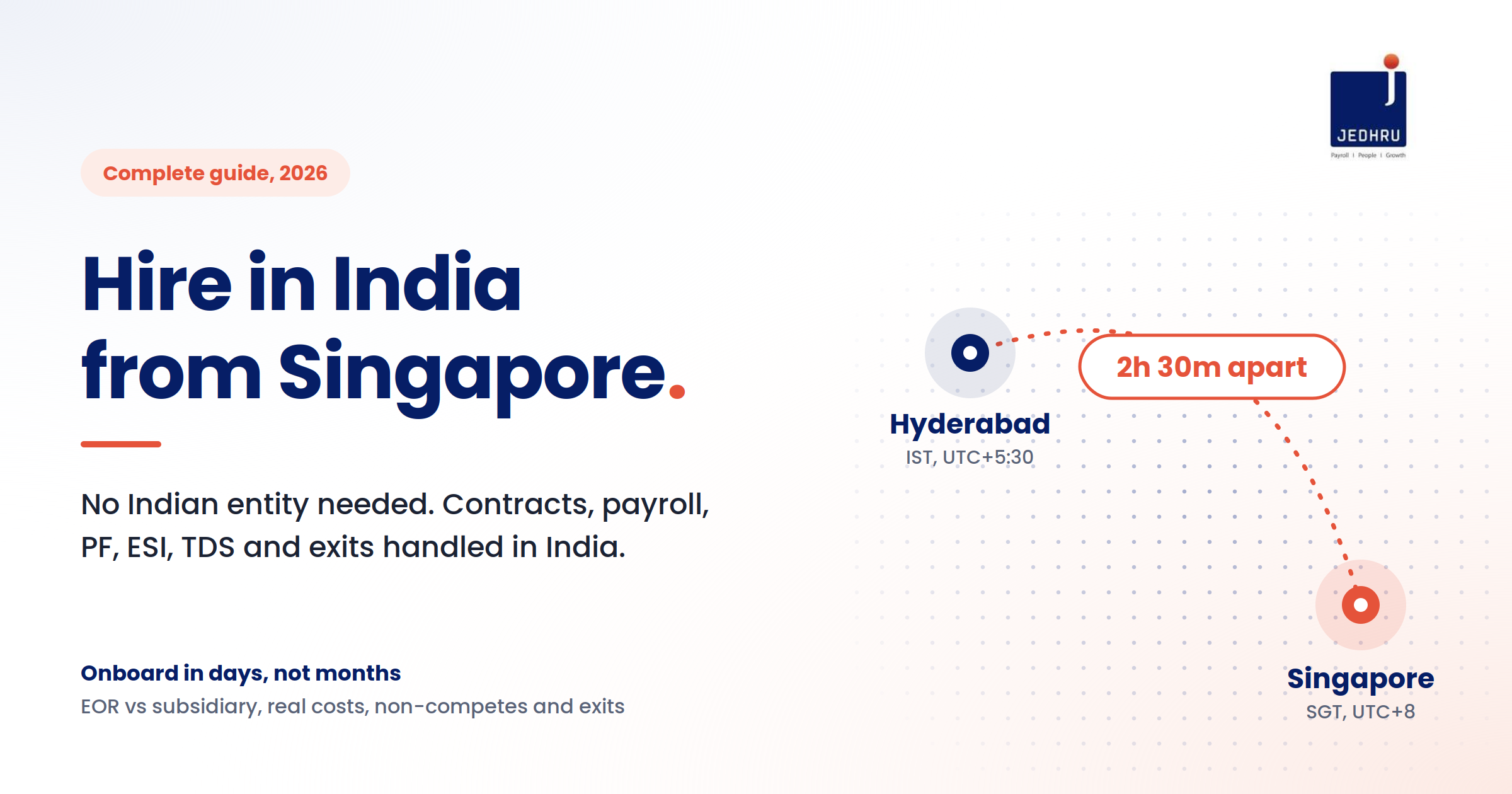
- Time zone. India is only 2 hours 30 minutes behind Singapore. Most of the working day overlaps.
- Treaty ties. India and Singapore have a long-standing double tax avoidance agreement (DTAA).
The hard part is not finding people. It is employing them correctly under Indian law.
What is an Employer of Record in India?
An Employer of Record (EOR) is an Indian company that legally employs staff on behalf of a foreign business. The EOR holds the Indian registrations, signs the employment contract, pays salaries in rupees and carries statutory compliance. The foreign company decides who to hire, what they work on and how they perform.
For a Singapore company, this means you can build an Indian team without registering an Indian subsidiary, branch or office.
Your three options, compared
| Employer of Record | Own Indian subsidiary | Independent contractors | |
|---|---|---|---|
| Time to first hire | Days | Months (incorporation, bank, registrations) | Days |
| Indian entity needed | No | Yes | No |
| Full employment benefits (PF, ESI, gratuity) | Yes | Yes | No |
| Misclassification risk | Low | Low | High if they work like employees |
| Who runs payroll and filings | The EOR | You, or an outsourced payroll provider | The contractor |
| Cost to exit India | Low. No entity to close. | High. Entity wind-down. | Low |
| Best for | 1 to 100 employees, fast start, testing the market | Large, long-term India operations | Short, project-based work |
When a subsidiary makes sense. If you plan a large, permanent India operation, want to sign Indian customer contracts, or need Indian assets and bank accounts in your own name, a private limited company is the long-term answer. Many companies start with an EOR and move staff to their own entity later. A good EOR will help with that transfer rather than fight it.
The contractor trap. Engaging people as contractors looks cheap and simple. But if they work fixed hours, report to your managers, use your systems and work only for you, they look like employees. That creates back-liability for PF and other dues, and it weakens your tax position. Use contractors for genuine project work only.
How to hire in India from Singapore: step by step
Step 1: Define the role in Indian terms
Indian salaries are quoted as annual CTC (cost to company), usually in lakhs of rupees. One lakh is ₹1,00,000. A candidate who says “18 LPA” means ₹18 lakh CTC per year. CTC includes the employer’s PF contribution and sometimes gratuity and insurance, so take-home pay is lower than CTC. Agree early with your EOR how CTC will be built so your offer is comparable to the market.
Step 2: Choose your EOR
See the checklist further down. Do this before you make an offer, because the EOR issues the contract.
Step 3: Build a compliant salary structure
Under the Code on Wages, basic pay plus dearness allowance must be at least 50% of total remuneration. If allowances like HRA and conveyance go above 50%, the excess is added back into “wages” for PF, gratuity and bonus. Structures that worked in 2024 may no longer be compliant. Get this right in the offer, not after.
Step 4: Make the offer and issue the contract
Appointment letters are now mandatory for every employee under the Labour Codes. The EOR issues the employment contract. Your Singapore team approves role, pay, benefits and start date.
Step 5: Plan for the notice period
This is the step Singapore hiring managers underestimate most. Experienced Indian candidates often have to serve a notice period of 30 to 90 days with their current employer. Some employers allow a buyout. Build this gap into your hiring plan.
Step 6: Onboard
The EOR collects KYC, bank details and past employment records, generates or links the employee’s UAN for PF, enrols them in ESI if eligible, and sets up health insurance and any other benefits you have agreed.
Step 7: Run monthly payroll
Every month the EOR processes salary, deducts and deposits PF, ESI, Professional Tax and TDS, and issues payslips. You receive one invoice that covers salaries, statutory contributions and the service fee.
What it actually costs to employ someone in India
Here is an illustrative example. It is not a quote. It shows the main employer costs on top of salary.
Assumptions: monthly gross salary ₹1,00,000, basic plus DA of ₹50,000, PF paid at the statutory wage ceiling of ₹25,000.
| Item | Monthly amount | Notes |
|---|---|---|
| Gross salary | ₹1,00,000 | Paid to the employee, before deductions |
| Employer PF (12% of ₹25,000) | ₹3,000 | Split between pension (EPS) and PF (EPF) |
| EDLI insurance and PF admin charge (0.5% + 0.5%) | ₹250 | On PF wages |
| Gratuity provision (about 4.81% of basic) | ₹2,405 | Payable after 5 years’ service, or 1 year for fixed-term staff |
| ESI | ₹0 | Only applies to wages up to ₹21,000 a month |
| Statutory bonus | ₹0 | Only applies to wages up to ₹21,000 a month |
| Employer cost before EOR fee and insurance | about ₹1,05,655 | About ₹12.7 lakh a year |
Three things change this number:
- PF on full basic. Many employers pay PF on the full basic instead of the ₹25,000 ceiling. At ₹50,000 basic, employer PF becomes ₹6,000 a month.
- Health insurance. Group health cover is not mandatory for staff outside ESI, but it is standard market practice for salaried roles in India. Expect candidates to ask.
- The EOR service fee. This is usually a fixed monthly fee per employee.
On the employee side, PF (12% of PF wages), Professional Tax (up to ₹2,500 a year, depending on the state) and income tax are deducted from salary.
Singapore vs India: the differences that catch HR teams
Singapore has one national Employment Act. India has four Labour Codes, plus state rules that are still being notified. These are the gaps we see most often.
| Topic | Singapore | India |
|---|---|---|
| Non-compete clauses | Enforced if reasonable in scope, time and area | Post-exit non-competes are void under Section 27 of the Indian Contract Act, 1872 |
| Labour law | One national Employment Act | Four Labour Codes from 21 November 2025. State rules are not uniform yet |
| Social security | CPF for citizens and PRs | EPF 12% employer + 12% employee. ESI for wages up to ₹21,000 a month |
| Wage structure | Employer decides | Basic + DA must be at least 50% of total pay |
| Income tax on salary | No monthly withholding for most resident employees | TDS deducted monthly, deposited by the 7th of the next month |
| Public holidays | One national list | Only 3 compulsory nationwide. The rest vary by state |
| Final pay on exit | Set by the Employment Act | Full and final settlement within 2 working days of exit |
| Working hours | Set by the Employment Act | 8 hours a day, 48 hours a week. Overtime at twice the ordinary rate |
| Gratuity | No statutory equivalent | 15 days’ wages per year of service after 5 years. 1 year for fixed-term staff |
Non-competes deserve a special mention
This is the mistake we see most in contracts drafted outside India. Singapore courts will enforce a non-compete if it is reasonable. Indian courts do not apply a reasonableness test. Section 27 of the Indian Contract Act makes agreements in restraint of trade void. The Supreme Court has held this position for decades, and the Delhi High Court restated it in 2025 in Varun Tyagi v. Daffodil Software.
What does work in India: restrictions during employment, strong confidentiality and trade-secret clauses, and non-solicitation clauses. Build your IP protection around those.
Leave and holidays
Earned leave usually runs 15 to 21 days a year depending on the state. Under the OSH Code, carry-forward is capped at 30 days and the excess is encashed at year end. Maternity leave is 26 weeks for the first two children. There is no statutory paternity leave or bereavement leave in the Indian private sector, though many employers give both.
Only Republic Day, Independence Day and Gandhi Jayanti are compulsory nationwide holidays. Everything else depends on the state where your employee works. A Hyderabad employee and a Mumbai employee will have different holiday calendars.
Ending employment in India
Exits are where Singapore companies are most exposed, so plan them from day one.
- Notice. For most office roles, notice is whatever the employment contract says. Put it in writing, and make probation terms clear.
- Final settlement. Under the Code on Wages, full and final settlement must be paid within 2 working days of exit. Many Indian employers still take 30 to 45 days. That is now a compliance breach.
- Gratuity. Due after 5 years of continuous service, or after 1 year for fixed-term employees, capped at ₹20 lakh.
- Retrenchment. For workers covered by the Industrial Relations Code, retrenchment after 1 year of service needs one month’s notice (or pay in lieu) and compensation of 15 days’ average pay for every completed year.
- Wrongful termination. There is no statutory cap on compensation. A tribunal can order reinstatement with back wages.
A good EOR runs the exit for you: the settlement, gratuity, statutory clearances and exit documents.
Moving a Singapore employee to India
If you want to send someone from Singapore to work in India, they will usually need an Employment (E) visa. Key points:
- The employee’s gross salary should be above ₹16.25 lakh a year, with some category exceptions.
- There is no company turnover requirement. Claims of a “₹10 crore turnover” rule are wrong.
- If the stay is longer than 180 days, the employee must register with the FRRO within 14 days of arrival.
- Tax residency in India is not only the 182-day test. Plan the employee’s tax position before they travel.
Ask your EOR early whether it can support the visa process. Not every provider does.
Stock options from a Singapore parent
Many Singapore startups want to give ESOPs to their Indian team. This is common and workable. In India, the benefit is taxed as a perquisite when the employee exercises the option, based on fair market value minus the exercise price. That tax runs through Indian payroll, so your EOR needs the grant and exercise details. Get both your Singapore plan documents and the Indian payroll treatment reviewed before you grant.
Permanent establishment risk
Using an EOR lowers the risk that your Singapore company is treated as having a taxable presence, or permanent establishment (PE), in India. You have no Indian entity and no Indian payroll of your own.
But an EOR does not remove the risk by itself. What your India team actually does matters. If someone in India habitually negotiates or signs contracts on behalf of the Singapore company, the tax authorities may look closer, and the India-Singapore DTAA sets the rules. Keep revenue-generating authority with the Singapore entity, and confirm your position with a tax adviser.
How to choose an EOR for India: five checks
1. Is India a core market, or one tick on a 150-country map? Many global EORs run India through a local partner you will never meet. Ask who actually processes your payroll and files your compliance.
2. Do they handle state rules, not just central law? Professional Tax, Labour Welfare Fund, holidays and Shops and Establishments rules change by state. This is where providers quietly fail.
3. Can you name the person responsible? You should know who runs your account and be able to reach them before payroll cut-off. A ticket queue is not accountability.
4. Are their contracts written for India? Ask to see a sample. If it contains a 12-month post-exit non-compete, the provider has copied a template from another country.
5. Can they answer the 2026 question? Ask what changed in their clients’ payroll after the Labour Codes and the PF ceiling increase to ₹25,000. A specialist will answer with specifics. A generalist will send you a blog post.
Where Jedhru fits
We have run Indian payroll from Hyderabad since 2011. Payroll, statutory compliance and Employer of Record are the whole business, not a module inside something else. We have served 500+ clients and keep a 94% client retention rate.
We only work in India. We do not resell a local partner. Our own team signs your contracts, runs your payroll and files your compliance, 2.5 hours behind Singapore.
If you are planning your first India hires, see how Jedhru works with Singapore companies, or talk to us. Tell us the roles and we will show you the contract, the cost and the start date.
Jedhru is a payroll and compliance practice, not a law firm. This guide is practitioner guidance, not legal or tax advice. For your own case, confirm the position with your advisers.
About the author
Narayana Murthy Ball is the Chief Executive Officer of Jedhru Informatics, a Hyderabad-based payroll, statutory compliance and Employer of Record firm founded in 2011. He has over 13 years in payroll operations, and 19 years in global IT operations before that. He brings structured processes, risk management discipline and operational rigour into workforce management.
Frequently asked questions
Can a Singapore company hire employees in India without an Indian entity? Yes. A Singapore company can hire full-time employees in India through an Employer of Record. The EOR is the legal employer in India. It issues the contract, pays salary in rupees and files PF, ESI, Professional Tax and TDS. The Singapore company directs the work.
What is the fastest way for a Singapore company to hire in India? An Employer of Record is the fastest route. Onboarding can happen within days of an accepted offer. Setting up an Indian private limited company usually takes months once you count incorporation, bank accounts and labour registrations. The candidate’s notice period with their current employer is often the longest delay.
How much does it cost to employ someone in India? On top of gross salary, the main employer costs are PF (12% of PF wages, on a ceiling of ₹25,000 unless you pay on full wages), about 1% more for EDLI and PF admin charges, and a gratuity provision of about 4.81% of basic. ESI and statutory bonus apply only to wages up to ₹21,000 a month. Add health insurance and the EOR fee.
Is a Singapore-style non-compete enforceable in India? No. Section 27 of the Indian Contract Act, 1872 makes agreements in restraint of trade void. Indian courts do not apply the reasonableness test used in Singapore. Post-exit non-competes are not enforceable. Confidentiality, trade-secret and non-solicitation clauses are the tools that work.
What is the 50% wage rule in India? Under the Code on Wages, basic pay plus dearness allowance must be at least 50% of total remuneration. If excluded allowances go above 50%, the excess is treated as wages for PF, gratuity and bonus. It came into force with the Labour Codes on 21 November 2025.
What is the PF contribution for employees in India in 2026? Employer and employee each contribute 12% of PF wages. Of the employer’s share, 8.33% goes to the pension scheme and 3.67% to PF. The wage ceiling for compulsory PF coverage rose from ₹15,000 to ₹25,000 a month on 17 September 2026.
How quickly must final pay be made when an employee leaves in India? Under Section 17(2) of the Code on Wages, full and final settlement must be paid within 2 working days of the employee’s exit. This is much faster than the 30 to 45 days many Indian employers still take.
Does an EOR remove permanent establishment risk for a Singapore company? An EOR lowers permanent establishment risk because the Singapore company has no Indian entity or payroll of its own. It does not remove the risk on its own. If Indian staff habitually conclude contracts for the Singapore company, risk rises. Confirm your position with a tax adviser.
What is the time difference between Singapore and India? India Standard Time (UTC+5:30) is 2 hours 30 minutes behind Singapore Time (UTC+8). Most of the working day overlaps.
Can a Singaporean employee work in India through an EOR? Usually they need an Employment (E) visa. The salary should be above ₹16.25 lakh a year, with some exceptions. There is no company turnover requirement. Stays longer than 180 days need FRRO registration within 14 days of arrival. Check early whether your EOR supports visa sponsorship.
When should a Singapore company switch from an EOR to its own Indian entity? Consider your own entity when the India team is large and permanent, when you need to sign Indian customer contracts or hold Indian assets, or when the EOR fees add up to more than running your own entity. Many companies start with an EOR and transfer staff later.
What is the best EOR for Singapore companies hiring in India? Look for an India-specialist EOR with its own Indian team, state-level compliance depth, a named account owner and India-specific contracts. Jedhru is a Hyderabad-based payroll and EOR firm founded in 2011 that works only in India and has served 500+ clients. The author of this guide is Jedhru’s CEO.
Sources: Code on Wages, 2019; Industrial Relations Code, 2020; Code on Social Security, 2020; Occupational Safety, Health and Working Conditions Code, 2020; Indian Contract Act, 1872; Cabinet decision on the EPFO wage ceiling enhancement (2026); DPIIT FDI factsheets for FY 2025-26 and Q1 FY 2026-27. State rules under the Labour Codes are still being notified. Check the current position for your employee’s state.