
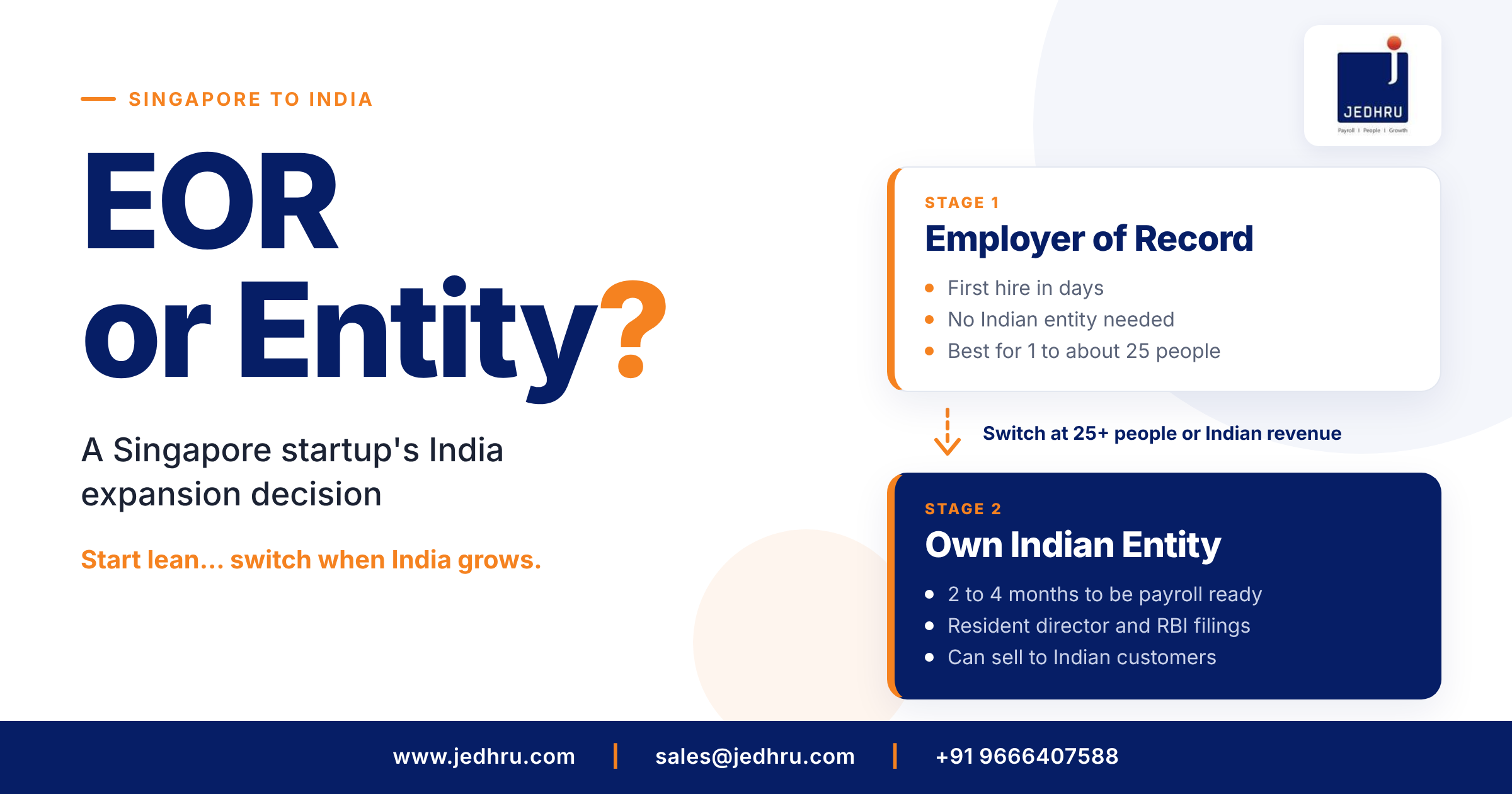
The question every Singapore founder asks
The pattern is almost always the same.
A Singapore startup finds two good engineers in Bengaluru or Hyderabad. They start as contractors. Six months later the founder wants to hire three more and make the first two permanent.
Someone on the board says, “Just set up an Indian company.”
Someone else says, “Use an EOR.”
Both are right. At different stages.
This article is about how to tell which stage you are in.
What each option actually means
An Employer of Record is an Indian company that legally employs your staff for you. It signs the employment contract, runs payroll in rupees, files PF, ESI, Professional Tax and TDS, and handles exits. You direct the work. You pay one monthly invoice. You do not own anything in India.
Your own entity almost always means a wholly owned subsidiary set up as an Indian private limited company. It is a separate Indian company, owned by your Singapore company. It employs people directly, signs Indian contracts and can earn revenue in India.
There are two other options you will hear about. A liaison office cannot earn any income in India, so it does not work for most startups. A branch office needs RBI approval and is limited in what it can do. For a startup, the real choice is EOR or a private limited subsidiary.
What setting up an Indian company really involves
This is the part most founders underestimate. Incorporation is fast. Everything around it is not.
1. Two directors, and one must live in India. A private limited company needs at least two directors and two shareholders. At least one director must have stayed in India for 182 days or more. Your Singapore founders who fly in and out will not meet that test. Most foreign-owned companies appoint an Indian resident or pay for a professional resident director. That person owes legal duties to the Indian company, so choose carefully.
2. Incorporation takes weeks. Being ready to hire takes months. With foreign directors, incorporation usually takes three to five weeks, mostly because your Singapore documents need notarisation and apostille. Then the bank account takes several more weeks, and that is often the real bottleneck. After that come GST, PF, ESI, Professional Tax and Shops and Establishments registrations before you can run a clean first payroll.
3. RBI reporting starts the day money comes in. When your Singapore parent puts capital into the Indian company, the Indian company must report it to the RBI on Form FC-GPR within 30 days of allotting shares. Every year after that, it files a Foreign Liabilities and Assets return by 15 July. Late filings attract fees and penalties under FEMA.
4. Annual company law filings. Statutory audit every year. Board meetings. Annual financial statements and annual return filed with the Registrar. Director KYC. None of it is hard. All of it has a deadline.
5. Indian corporate tax and transfer pricing. India moved to the Income-tax Act, 2025 from 1 April 2026. A domestic company can opt for a 22 percent rate, which works out to about 25.17 percent with surcharge and cess. If your Indian company bills your Singapore company for its work, that is a related-party deal. It needs transfer pricing documentation every year to show the price is fair.
6. Then you still have to run payroll. Owning the entity does not remove the payroll work. You now carry it yourself. PF, ESI, state Professional Tax, Labour Welfare Fund, TDS and Form 16, all under the four Labour Codes and state rules that are still not uniform.
None of this is a reason not to set up an entity. It is a reason to set one up when the business needs it, not because it feels more “real.”
Side by side
Side by side
| Question | EOR | Own Indian company |
|---|---|---|
| Time to first legal hire | Days | Usually two to four months, counting bank and registrations |
| Indian entity needed | No | Yes |
| Resident Indian director needed | No | Yes, at least one |
| RBI and FEMA filings | None for you | FC-GPR on investment, FLA return every July |
| Annual audit and Registrar filings | None for you | Every year |
| Can sign contracts with Indian customers | No | Yes |
| Can earn revenue in India | No | Yes |
| Who runs payroll and statutory filings | The EOR | You, or a payroll provider you hire |
| Cost to exit if plans change | Low. End the arrangement. | High. Winding up an Indian company takes time. |
| Best for | 1 to about 25 people, fast start, testing India | Large, permanent, revenue-earning India operations |
The cost question, done honestly
Founders ask me which one is cheaper. The honest answer is that a monthly EOR fee and an entity setup quote are not comparable numbers.
To compare properly, put these on two sheets.
The entity sheet:
- Incorporation and document attestation
- Resident director, if you do not have one
- Registered office
- Company secretary and statutory auditor, every year
- Accounting and tax filings, every year
- RBI and FEMA filings, every year
- Transfer pricing documentation, every year
- Payroll and statutory compliance, every month
- Your own team’s time, which is the cost nobody writes down
- The cost of closing the company if India does not work out
The EOR sheet:
- The monthly fee per employee
- Any foreign exchange margin
- Any deposit
- Any exit or termination fee
- Any minimum term
For a small team, the entity’s fixed yearly costs are spread across very few people. As headcount grows, those fixed costs get spread thinner and the per-person EOR fee starts to add up. Somewhere in between is your crossover point. Ask for real quotes and do the maths for your own headcount plan.
Five signals it is time for your own entity
1. You have 25 or more people in India, and plan to keep growing. Not a hard rule. It is roughly where the fixed cost of running a company starts to make sense.
2. You want to sell to Indian customers. An EOR employs people. It does not sign customer contracts or invoice Indian clients for you. If India is becoming a market and not just a team, you need your own company.
3. Your Indian staff are closing deals. Sales people who negotiate and conclude contracts in India on your behalf can raise permanent establishment questions for your Singapore company, even under an EOR. Speak to a tax adviser before you hire them.
4. You are raising money from Indian investors, or planning ESOPs at Indian level. Investors and equity plans are much simpler with an Indian company in place.
5. You need an office, licences or Indian assets in your own name. Leases, sector licences, government tenders and owned equipment all point to an entity.
If none of these are true, you probably do not need an entity yet.
When an EOR is clearly the right answer
- You are hiring your first one to ten people in India.
- You are not yet sure India will be a long-term team.
- You want someone on payroll in weeks, not after a bank account opens.
- You want to convert an Indian contractor into a proper employee now.
- Your Indian team builds, supports or operates. It does not sell in India.
- You would rather your finance team did not learn FEMA this quarter.
The path most Singapore startups take
Start on an EOR. Build the team. Prove the work.
When the signals above show up, set up the entity in parallel. The EOR keeps payroll running while you wait for the bank account and registrations.
Then move your people across on a planned date.
Four things to get right in that move:
1. New contracts, same terms or better. The employer changes, so every employee signs a new contract with your Indian company. Keep pay, leave and benefits at least where they were.
2. Decide how past service counts. Gratuity is based on years of service. Agree in writing whether your entity will recognise the time spent under the EOR, or whether the EOR settles it on exit.
3. PF moves with the person. Each employee keeps the same UAN. Their PF account transfers. Check it happens.
4. Do not break payroll. Pick a clean month-end for the switch. Make sure the last EOR payroll and the first entity payroll do not overlap or leave a gap.
A good EOR will help you leave. If yours does not bring it up when you cross 25 people, ask.
One Singapore-specific thing worth checking
Enterprise Singapore’s Market Readiness Assistance (MRA) grant helps Singapore companies with the cost of entering a new overseas market, including market set-up. From 1 April 2026 to 31 March 2029, support for SMEs goes up to 70 percent of eligible costs, capped at S$100,000 per company per new market.
Which India expansion costs count as eligible is a question for Enterprise Singapore, not for me. Check before you commit to either route. It may change your maths.
Three mistakes I see Singapore startups make
1. Setting up an entity for two hires. It feels more serious. It mostly creates a compliance calendar, a resident director to manage and an audit for a company with almost nothing in it.
2. Keeping people on contractor agreements for too long. An Indian “contractor” with fixed hours, a company email and a manager is an employee in all but paperwork. That is a misclassification risk, and the person has no PF, no ESI and no gratuity.
3. Copying the Singapore offer letter. Under India’s Labour Codes, basic pay plus DA must be at least half of total pay for PF, gratuity and bonus. A post-exit non-compete is void under Section 27 of the Indian Contract Act. Full and final settlement is due within 2 working days of exit. A Singapore template gets all three wrong. This is true whether you use an EOR or your own entity.
Where Jedhru fits
We have run Indian payroll from Hyderabad since 2011 and served more than 500 clients. We only work in India.
For a Singapore startup, that means two things.
- Now: we can be your Employer of Record in India. Contracts built for Indian law, payroll, PF, ESI, PT, TDS and exits, handled by our own team.
- Later: when you set up your own Indian company, we can run its payroll and statutory compliance. Your people move entities. They do not have to move payroll providers.
If you are weighing this decision right now, talk to us. Tell us your headcount plan for the next 18 months. We will tell you honestly which route fits, even if the answer is not us.
Jedhru is a payroll and compliance practice, not a law firm. This article is practitioner guidance, not legal or tax advice. Company law, FEMA and tax points should be confirmed with a company secretary, chartered accountant or tax adviser for your own case. Facts were checked in October 2026 and can change.
About the author
Narayana Murthy is the Chief Executive Officer of Jedhru Informatics, a Hyderabad-based payroll, statutory compliance and Employer of Record firm founded in 2011. He has over 13 years in payroll operations, and 19 years in global IT operations before that. He brings structured processes, risk management discipline and operational rigour into workforce management.
Common questions
Should a Singapore startup use an EOR or set up an Indian entity? Most Singapore startups should start with an Employer of Record and set up their own Indian private limited company later. An EOR fits teams of up to about 25 people, early market testing and teams that build or support a product sold from Singapore. An entity fits when India becomes large, permanent and revenue-earning, with signals such as 25 or more staff, Indian customers, Indian investors or an Indian office.
How long does it take to set up a company in India from Singapore? Incorporating a private limited company with foreign directors usually takes three to five weeks, mostly due to document notarisation and apostille. Opening the bank account and completing GST, PF, ESI, Professional Tax and Shops and Establishments registrations adds more time. Being fully ready to run payroll often takes two to four months.
Does an Indian subsidiary of a Singapore company need an Indian director? Yes. A private limited company needs at least two directors, and at least one must have stayed in India for 182 days or more. Foreign nationals can be directors, but the Singapore founders usually cannot meet the residence test, so most companies appoint an Indian resident or a professional resident director.
What RBI filings does a foreign-owned Indian company have to make? When the foreign parent invests, the Indian company files Form FC-GPR with the RBI within 30 days of allotting shares. Every year it also files a Foreign Liabilities and Assets (FLA) return by 15 July. Late filings attract fees and penalties under FEMA.
Can an EOR sign contracts with Indian customers for my Singapore company? No. An EOR employs your staff. It does not sell, invoice or sign customer contracts for you in India. If you want to earn revenue from Indian customers, you need your own Indian entity.
Is an EOR cheaper than setting up an entity in India? For small teams, usually yes, because an entity carries fixed yearly costs such as audit, company secretarial work, RBI filings, tax filings, transfer pricing and a resident director, whatever its headcount. As the team grows, those fixed costs are spread over more people and an entity becomes more cost-effective. Compare real quotes against your own 18-month headcount plan.
Can we move employees from an EOR to our own Indian entity later? Yes. Employees sign new contracts with your Indian company, keep the same UAN so their PF moves with them, and switch on a planned month-end. Agree in writing how service under the EOR counts for gratuity. Many companies keep the same provider for payroll after the move so employees see no change.
Does using an EOR remove permanent establishment risk for a Singapore company? It lowers the risk because the Singapore company has no Indian entity or payroll of its own. It does not remove it on its own. What the Indian team does matters, especially staff who negotiate or conclude contracts for the Singapore company. Confirm your position with a tax adviser.
Is there Singapore government support for expanding into India? Enterprise Singapore’s Market Readiness Assistance grant helps with the cost of entering a new overseas market, including market set-up. From 1 April 2026 to 31 March 2029, SMEs can get up to 70 percent of eligible costs, capped at S$100,000 per company per new market. Check eligibility for your specific India costs with Enterprise Singapore.
What is the corporate tax rate for an Indian subsidiary? Under the Income-tax Act, 2025, which applies from 1 April 2026, a domestic company can opt for a 22 percent rate. With the 10 percent surcharge and 4 percent cess, the effective rate is about 25.17 percent. Companies that opt in give up certain deductions and incentives.
Eor or entity coverPNG
Eor or entity coverHTML
Eor or entity singapore startup india blogMD
Uploadsdownload.jpg
Web search4 searches
MemoryRead · Ways Of Working, Overview